Coral Gables / Miami-Dade Redevelopment and Zoning
Local code, zoning, redevelopment approvals, Miami-Dade overlays, Live Local Act issues, and entitlement diligence for ZIP 33134.
Florida Research for the Questions That Take Too Long
Bach Atlas turns a difficult Florida question into a reviewable first-pass research foundation across statutes, local law, procedure, and case law — often in minutes. Review the authorities. Go deeper where it matters. Keep your judgment.
You do not have to believe an AI sales claim. Give Bach a Florida question you already understand well enough to judge, inspect what supports the answer, and decide whether the time saved deserves a place in your practice.
One Difficult Florida Question
A recent land-use regression asked Bach to connect a FLUM amendment, zoning-map amendment, PAD approval, conditional-use / mixed-use site-plan approval, legislative versus quasi-judicial classification, neighboring-owner standing, and Florida Supreme Court / Third DCA review.
First-Pass Runtime
A difficult Coral Gables land-use research run.
Authority Review
Cases, statutes, rules, local law, and official material organized for review.
Pre-Publication Audit
The answer is audited before the attorney-facing result is published.
Case Law Deep Dive
Additional case law ranked by legal potency, not favorability.
The first pass is not required to pretend it found everything. It is designed to establish a serious legal map quickly. When the attorney wants more appellate depth, Case Law Deep Dive searches around the existing research and ranks additional cases by legal potency — including adverse and limiting authority.
What Happens With a Hard Question?
The familiar parts stay familiar: question, authorities, cases, matter, review. Bach changes the speed, organization, and depth available between those steps.
Facts, posture, jurisdiction, and the legal issue can stay messy. Bach turns the question into a research problem without asking counsel to learn a new research language.
Bach researches Florida statutes, local authority, procedure, and case law where available, then produces a structured answer with visible limits instead of pretending one pass is exhaustive.
Authority Review separates the source layers and keeps counsel review distinct from machine checks. You can read, search, confirm, or flag what deserves more attention.
Case Law Deep Dive searches for additional controlling, supporting, limiting, distinguishing, and adverse authority, ranks the results, and helps narrow what still belongs in Research Next.
Recognize the Problem?
The point is not to convince every lawyer to use AI. It is to remove the research friction from matters where the first useful legal map takes too long to assemble manually.
The fastest way to decide is to use a question you already know well enough to challenge.
Test Bach on Your QuestionWhat You Actually Get
The product is not another text box. The value is keeping the question, research, authorities, deeper case law, remaining gaps, matter strategy, and drafting context connected.
A structured first-pass answer with governing authority, practical implications, coverage limits, and corrections applied before publication.
Cases, statutes, rules, local law, procedure, and official sources are separated into a reviewable authority layer rather than left as a citation dump.
Optional second-pass case research that ranks additional authority by court hierarchy, jurisdiction fit, directness, material relevance, current-law fit, and adverse significance.
Keep related research together, see what remains incomplete, and progressively narrow the open research questions instead of starting over each time.
Use the accumulated research to organize strategy coverage and procedural checkpoints when the matter needs more than a single answer.
Preserve the detailed legal foundation and hand it to Claude, ChatGPT, Copilot, or another approved drafting tool so the writing model starts with researched context.
Keep the Drafting AI You Already Like
Bach is not asking the firm to replace Claude, ChatGPT, Copilot, Westlaw, Lexis, or attorney judgment. It gives the downstream writing workflow a better researched starting point.
Bach Atlas
Build the Florida legal foundation, expose limitations, review the authorities, deepen case law only where needed, and preserve the matter context.
Claude / ChatGPT / Copilot / Firm AI
Use the research packet to create the memo, motion, advisory, letter, proposed order, or other work product without asking the drafting model to rebuild the entire legal foundation from zero.
Where Bach Has the Sharpest Edge
Bach can support many Florida questions. Its clearest advantage appears when statewide law, local code, local procedure, and appellate authority have to be understood together.
Comprehensive plans, zoning codes, local procedure, quasi-judicial standards, administrative review, and appellate authority in one research path.
Ordinances, charters, local procedure, code enforcement, public-law remedies, and Florida appellate authority where local layers matter.
Property, title, foreclosure, development approvals, local regulation, and Florida statutory overlays across a single matter.
Lien law, licensing, Chapter 558, notice chains, deadlines, local permitting, and litigation authority that frequently cross procedural layers.
Chapters 718 and 720, declarations, enforcement, injunctions, mediation, fees, local issues, and appellate authority where available.
When the litigation question depends not only on statewide doctrine but also on local procedure, ordinance text, property regulation, or a jurisdiction-specific rule.
See the Research, Not Just the Marketing
Open the work and judge the structure, authority trail, coverage notes, and practical usefulness for yourself.
Local code, zoning, redevelopment approvals, Miami-Dade overlays, Live Local Act issues, and entitlement diligence for ZIP 33134.
Certified payroll failures, Davis-Bacon, Miami-Dade responsible wage rules, 1099 misclassification, prime contractor exposure, and corrective action planning.
Self-help doctrine, pre-suit mediation, homeowner defenses, Chapter 720 fees, Florida-Friendly Landscaping, and filing sequence.
Notice requirements, timing deadlines, lien priority, and consequences of defective or untimely construction-lien notices on private commercial projects.
A familiar Florida real-estate and litigation issue showing Bach’s research structure and authority organization.
A land-use sample showing how Bach handles local-government constraints, development conditions, and Florida authority.
Professional Control Stays With Counsel
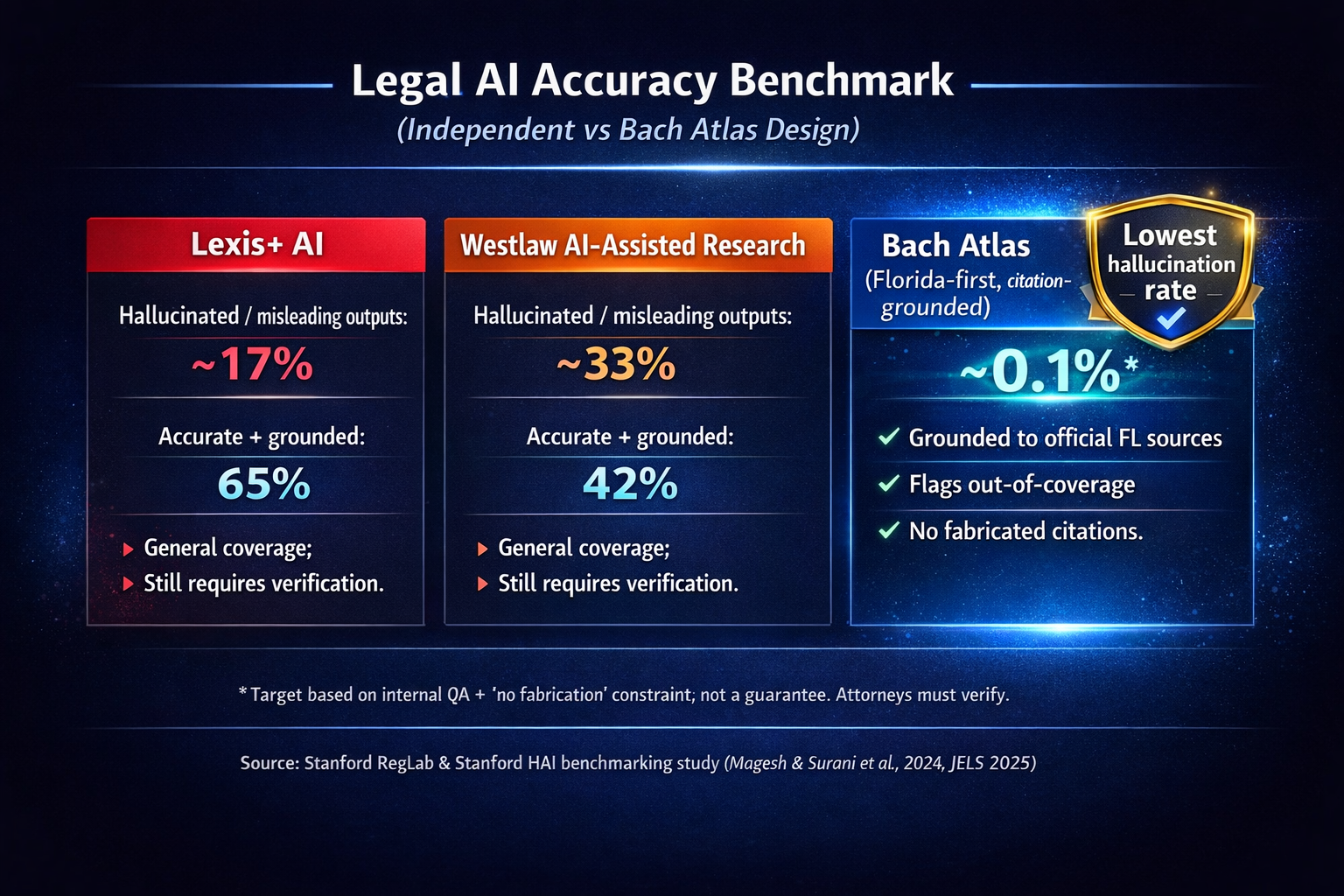
The point is not zero-risk automation. The point is a workflow where weak support, unresolved gaps, and citation problems are harder to hide and easier for the attorney to inspect before reliance.
Bach organizes research and review. The attorney still owns legal judgment, client strategy, case treatment, factual posture, and the final work product.
Bach can say when a source layer, local criterion, jurisdiction, or research question remains incomplete instead of smoothing the gap into confident prose.
Your research questions and generated outputs are not used to train models, with tenant isolation and retention terms handled in the engagement.
Atlas can organize authorities and search paths, but only counsel can mark an authority as personally reviewed or requiring follow-up.
Accuracy Still Matters More Than Speed
Bach is designed around a reviewable authority trail rather than a polished answer that asks counsel to reverse-engineer where the propositions came from.
See the Product Move
Watch the basic research flow, then test it on a Florida question you know better than we do.
Common Questions
The Decision Is Smaller Than “Adopt AI”
Would you rather spend the next few hours assembling the first research map yourself — or see what Bach gives you first?
Use a question you already understand. Inspect the authorities and limitations. Go deeper only if the matter warrants it. Then decide for yourself.
Bach Atlas is a research and verification support tool for licensed professionals. It is not a law firm, a citator, or a substitute for attorney judgment, good-law review, or review of the underlying authorities and final work product.